



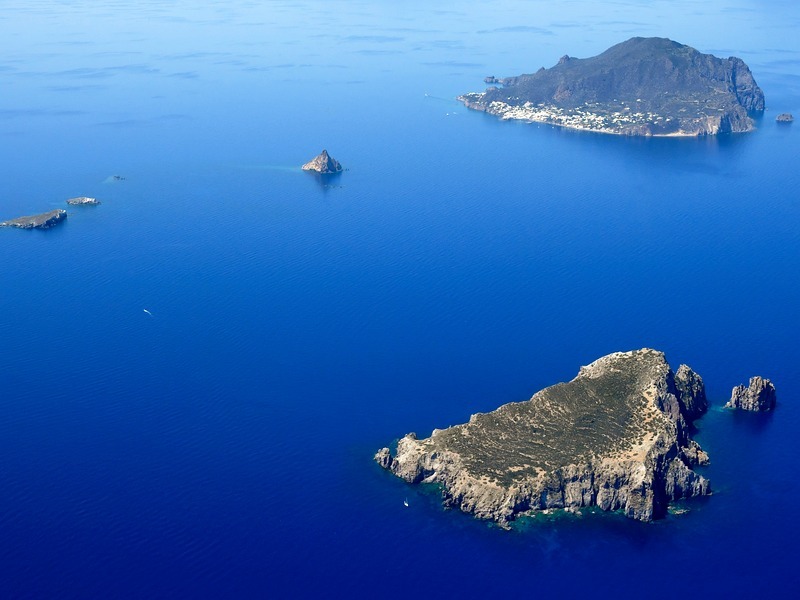
A week around the Aeolian Islands is about 110 nautical miles — the shortest sailing week we run anywhere. Seven volcanic islands sit within sight of each other off northern Sicily, most legs are three to fourteen miles, and the point of the week is not the sailing. It is spending a night at anchor under an erupting volcano. Here is the route, the distances, and the honest version of what the wind does in June.
The loop, six nights from Capo d’Orlando
| Day | Leg | Night | nm |
|---|---|---|---|
| Sat | Board 16:00 · Capo d’Orlando → Vulcano | Vulcano, buoy | 22 |
| Sun | Vulcano fumaroles and mud, Bocche → Lipari, big provisioning run | Lipari, Valle Muria | 10 |
| Mon | Lipari → Cala Junco → Stromboli, Sciara del Fuoco at dusk | Stromboli | 26 |
| Tue | Stromboli → the islets → Panarea | Panarea, Drauto | 14 |
| Wed | Panarea → Salina, granita at Lingua | Salina, Santa Marina | 12 |
| Thu | Salina → Pollara → Filicudi, Bue Marino and La Canna | Filicudi, Pecorini | 14 |
| Fri | Filicudi → Capo d’Orlando, back by 18:00 | — | 25 |
About 123 miles as planned, 111 miles once routed properly — around the island contours, minimum seven metres of water, fifty metres off the rock. Six nights, seven islands.
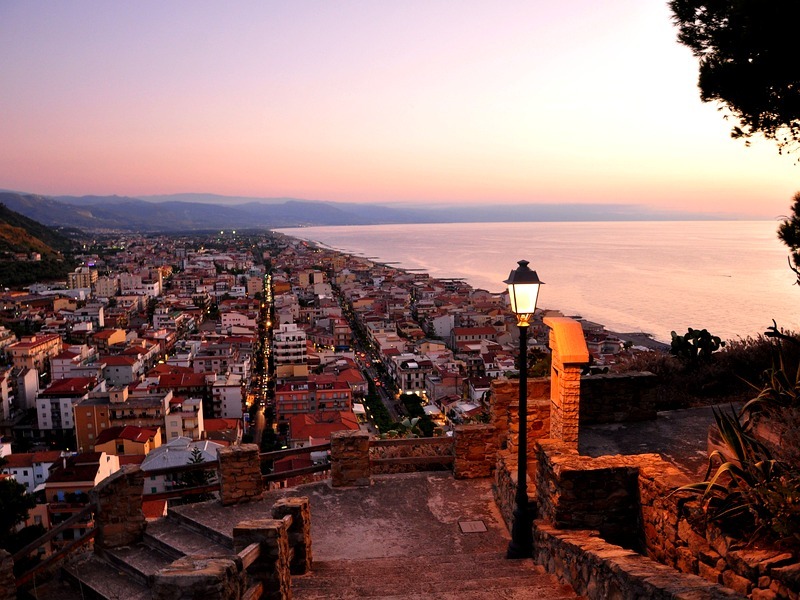
The honest part: this is not a wind week
Brochures show taut sails off Stromboli. In June, under the light anticyclonic regime that dominates the Tyrrhenian, a realistic forecast across the archipelago reads four to eight knots, occasionally ten. That is not sailing wind. It means a week largely under engine, at six knots and roughly five litres an hour.
We would rather say so in advance. If what your group wants is a boat heeled over with the rail down, the Cyclades in the meltemi or the Balearics in a spring tramuntana will give you that and the Aeolians will not. What the Aeolians give you is the volcanoes, and they give them at a distance no other archipelago in the Mediterranean can match.
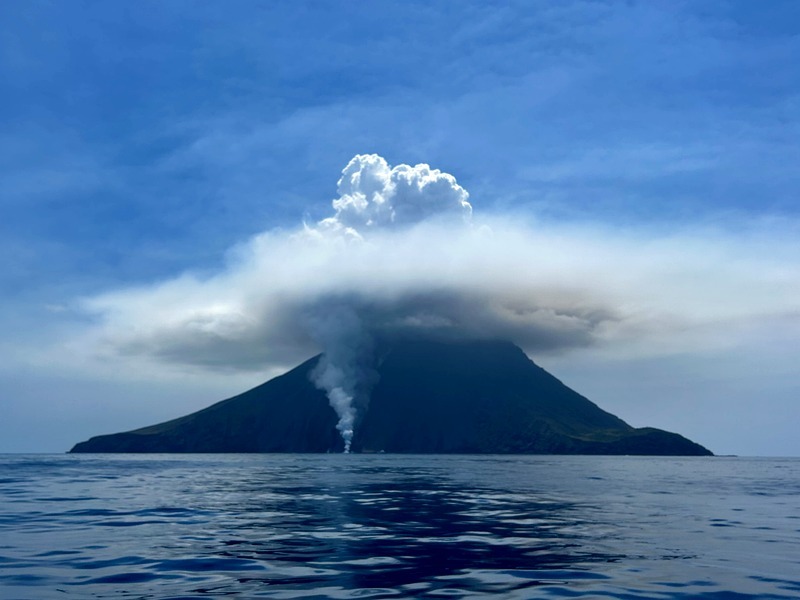
The night under Stromboli
This is the reason for the week, and it is worth understanding how it actually works.
You approach Stromboli from the east, with Strombolicchio — the basalt plug with a lighthouse on top, all that remains of an older cone — on the port quarter. By late afternoon you pick up a buoy at Punta Lena, about six hundred metres north of Scari. The island has almost nothing in the way of shelter; this is the practical mooring.
Then you wait for dark. The Sciara del Fuoco is the scar down the north-west flank where the ejected material runs to the sea, and it is only visible from the water. Stromboli has been erupting more or less continuously for a couple of thousand years, in short bursts every ten to twenty minutes. From the deck of a boat, in the dark, with the engine off, you watch incandescent rock arc off the summit and roll two thousand feet down into the sea.
No road goes there. No hotel looks at it. You either come by boat or you climb the volcano with a guide.
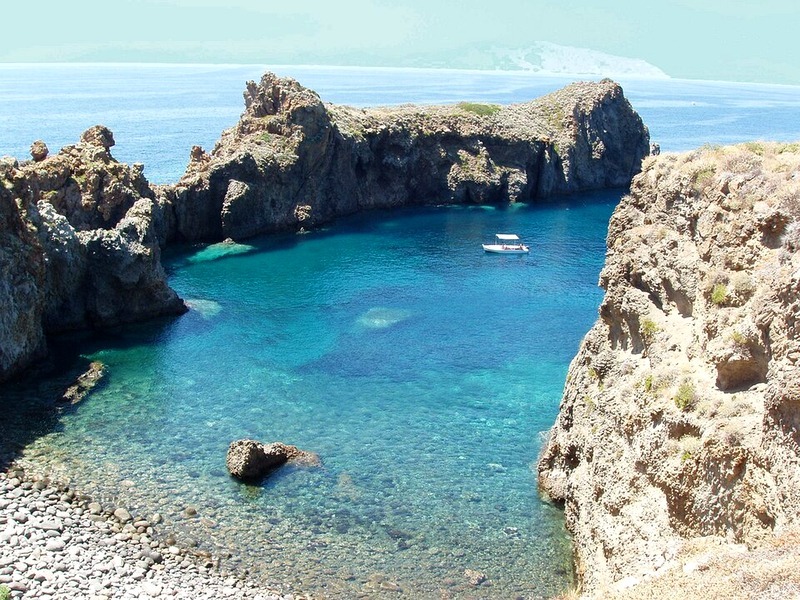
What the anchorages are actually like
Vulcano, Porto di Levante — wide and well sheltered from the prevailing north-westerlies, which makes it the natural first night. Sulphur on the breeze as you drop the hook; you get used to it faster than you expect.
Pollara is a morning-only stop. A half-crater on the western edge of Salina, yellow tuff cliffs dropping sheer into green water — and one of the most photographed spots in the archipelago. It is also rocky on the bottom and open to the sea. We anchor there for a morning and we do not sleep there. This is the kind of thing that decides whether a week feels well run.
Cala Junco, on the south coast of Panarea, is a natural pool walled in by red rock. Five metres on clear sand, swim from the stern. On the headland above sits a Bronze Age village.
Bottaro and Lisca Bianca, the islets north-east of Panarea, are where you swim through water that fizzes. Volcanic gas still vents through the sea bed and comes up around you in strings of bubbles. It is completely safe and thoroughly strange.
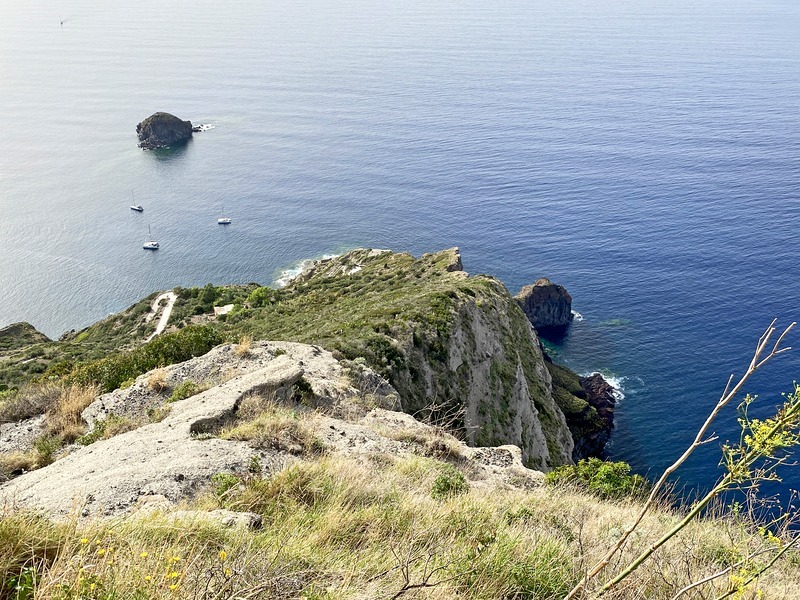
Pecorini a Mare on Filicudi is a buoy off a single row of houses on a stony shore. No chain stores, no traffic. The trattorias open as the sun goes down. Filicudi is the wild one — fewest people, fewest comforts, closest to what the others used to be.
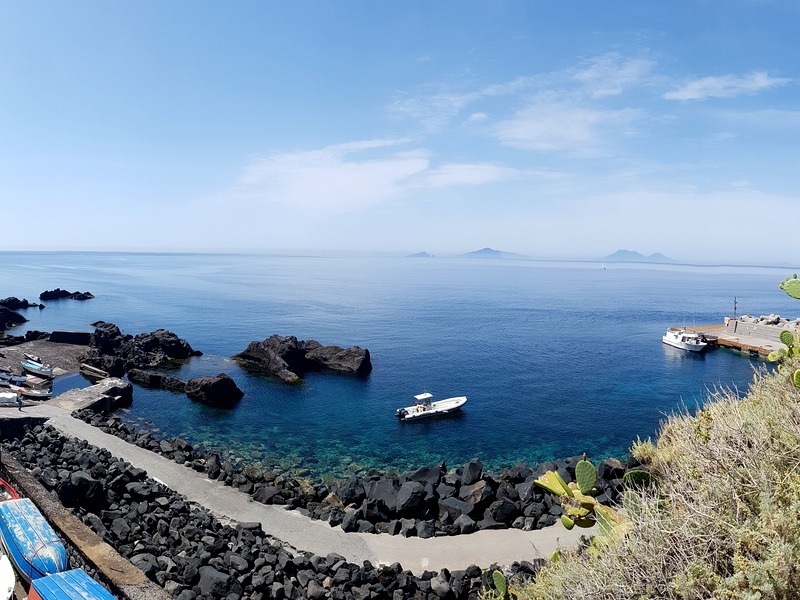
Ginostra, if the sea allows
On Stromboli’s south-western flank, thirty people live in a village with no road, no cars and no scooters — just a steep mule path up from the water. Its harbour, Pertuso, is often called the smallest port in the world; a couple of boats fit and that is it.
Rounding the island at first light to tie up there is one of the better hours of the week. It is also entirely dependent on the swell, which is why it sits on the plan as an option and not a promise.
Every stop has a plan B
An archipelago of seven volcanoes in open sea has very little natural shelter, and the wind here is thermal and local as much as synoptic — it accelerates between islands and behaves differently on either side of the same rock. So each night on the plan carries an alternative, and we decide the day before, not in January.
In practice the archipelago is small enough that this costs you nothing: from almost anywhere in it, somewhere sheltered is under two hours away.
When to go
| Period | What to expect |
|---|---|
| May – June | Our window. Warm, stable, islands still quiet, water fresh but swimmable. |
| July – August | Hot and crowded; Panarea in particular fills with day boats. Book early. |
| September | Excellent. Warmest water of the year, the crowds gone. |
| October onward | The weather becomes unreliable and the islands close down. |
What a week costs
From €6,000 for the week for the whole boat with your skipper included — about €950 per person with six aboard. Provisioning, fuel and harbour and mooring fees are shared by the group on top. On this route fuel is a real line rather than a rounding error: budget for a week mostly under engine.
Common questions
Will we definitely see Stromboli erupting?
Almost certainly, but not guaranteed by us. The volcano is in near-continuous activity, so the usual limiting factors are cloud and sea state at the mooring rather than the mountain. We plan the night there early in the week precisely so there is room to try again later if the first attempt is a washout.
Is it safe to anchor under an active volcano?
Yes. Stromboli’s ordinary activity is small, frequent and confined to the Sciara del Fuoco, and the mooring is on the other side of the island from it. Italian civil protection monitors the volcano continuously and restricts the sea area when it needs to. We follow those restrictions.
Is a hundred miles too little for a week?
It is short, and deliberately so. Short hops mean you are anchored by early afternoon most days, with time to swim, walk up to a village and eat ashore. If your group wants long days on the water, the Cyclades or the Arctic coast will suit you better.
Is this itinerary fixed?
No. The islands are fixed, the order is not. The week is built with you and then adjusted as the forecast moves — on this archipelago that means most days, not most weeks.
Sailing this?
See the Aeolian Islands odyssey, or tell us your dates and we’ll tell you honestly what the week can look like. You can also read what our crews wrote afterwards.
5.0/5 on Google (9 reviews) and 4.5 on Trustpilot (13 reviews). 22 reviews from crews who actually sailed with us, on two platforms we cannot edit. Read every one of them.