



Sailing from Mallorca to Ibiza and back is about 255 miles with two open-water night crossings — sixty miles out, sixty-nine back — and a national park at the end where you cannot anchor at all. Most Ibiza charters day-hop from Ibiza town. This is the version that starts in Palma, takes in Formentera, and finishes at Cabrera. Here is the route, and the three things that catch people out.
The route, out of Palma
| Leg | nm | |
|---|---|---|
| Palma → Caló des Porcs, Ibiza | 60 | Night crossing, dawn arrival |
| → Sa Conillera | 15 | Uninhabited islets, one lighthouse |
| → Cala Comte | 1 | Pale sand, the sunset walk above the rocks |
| → Cala d’Hort, Es Vedrà | 5 | Four hundred metres of rock straight out of the sea |
| → Ses Salines | 8 | Salt flats behind, aircraft low over the mast |
| → Ses Illetes, Formentera | 7 | The sand tongue. The clearest water of the week. |
| → Es Palmador | 3 | Shallow enough to check the depth twice |
| → Santa Eulalia | 14 | Marina, Puig de Missa, dinner ashore |
| → Aguas Blancas | 5 | Only on a calm day |
| → Es Caragol, Mallorca | 69 | Night crossing, morning arrival |
| → Cabrera | 9 | National park. Buoys only, booked in advance. |
| → Palma | 28 | Home under the Cathedral |
223 miles in straight lines, around 255 once you follow the coast.
The two crossings are the point
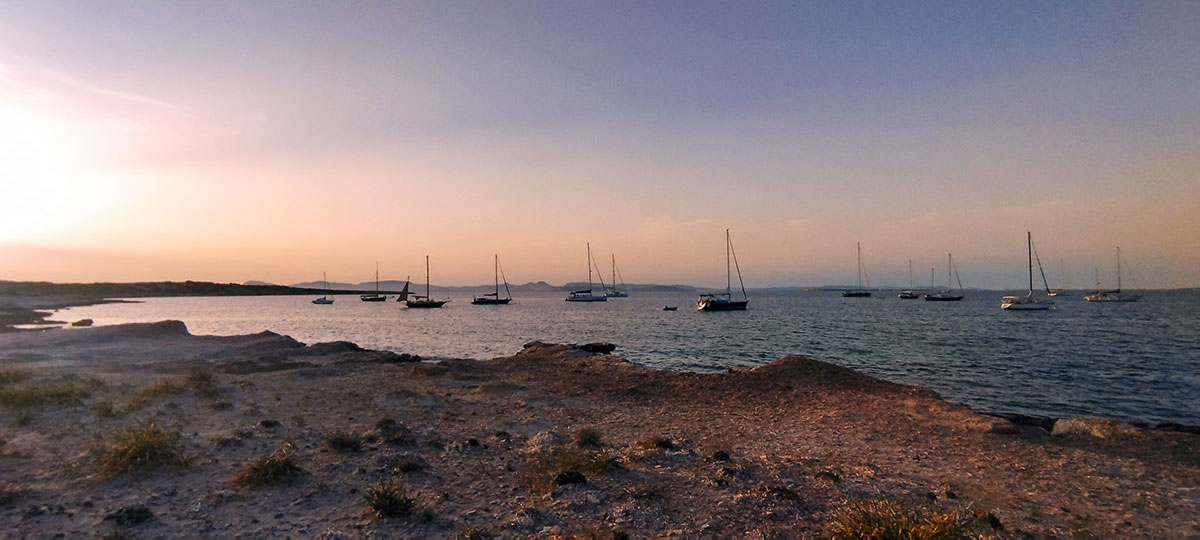
Between Mallorca and Ibiza there is sixty miles of nothing. No island, no shelter, no bail-out. At a working six knots that is ten hours, which is why both crossings are done overnight: leave in the evening, dinner under way, arrive into a quiet cove at first light for breakfast and a swim.
This is the difference between this week and the Ibiza charter you will be offered everywhere else. Most operators base you in Ibiza and hop you round the same fifteen miles of coast. Starting from Palma turns the week into two real passages with an archipelago in the middle — and it puts Cabrera within reach on the way home, which an Ibiza-based week never does.
If nobody in your group wants a night at sea, say so and we will start you in Ibiza instead. It is a good week too. It is just a different one.
Cabrera: book it or you don’t go
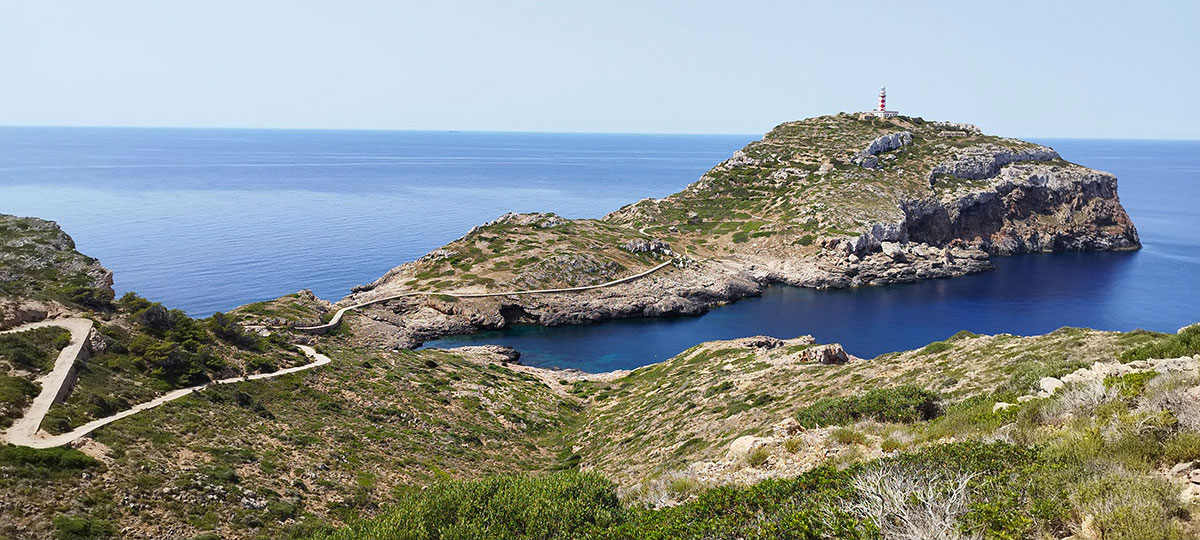
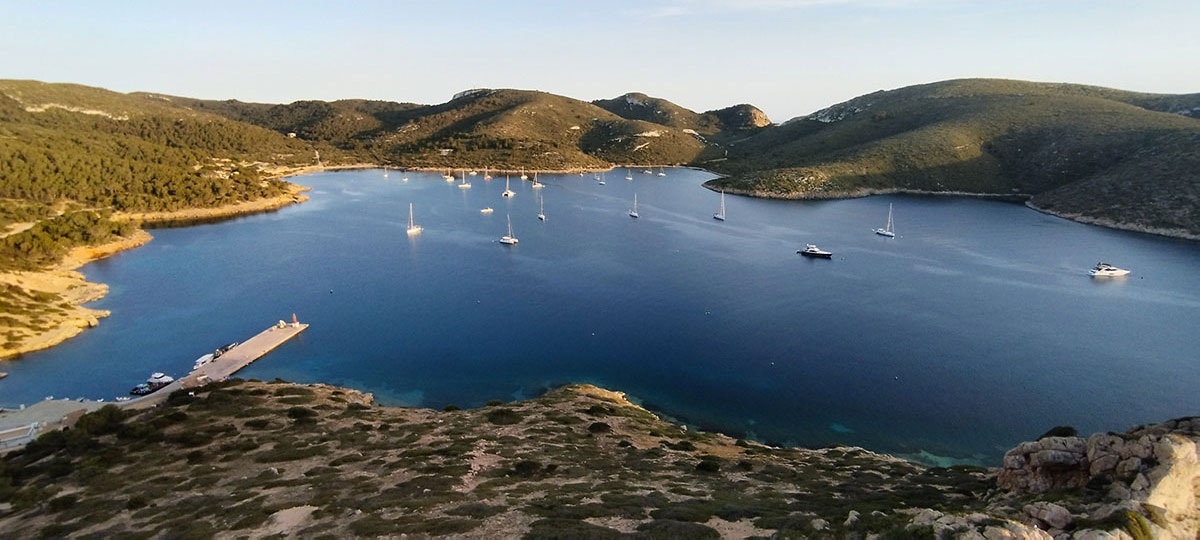
This is the single most useful thing on this page. Cabrera is a national park, and anchoring is prohibited throughout the archipelago. You moor on a numbered park buoy, and those buoys must be reserved in advance through the park authority. In July and August they go early.
People plan the week, sail down to Cabrera on the Friday, and discover there is nowhere to put the boat. We book the buoy when we build the itinerary, and if we cannot get one, the week is drawn differently rather than hopefully.
It is worth the administration. Cabrera has been protected since 1991, has almost no development, and the water clarity is on a different scale from anywhere else in the Balearics. There is a fourteenth-century castle above the harbour and a walk up to it that takes twenty minutes.
Two more things that catch people out
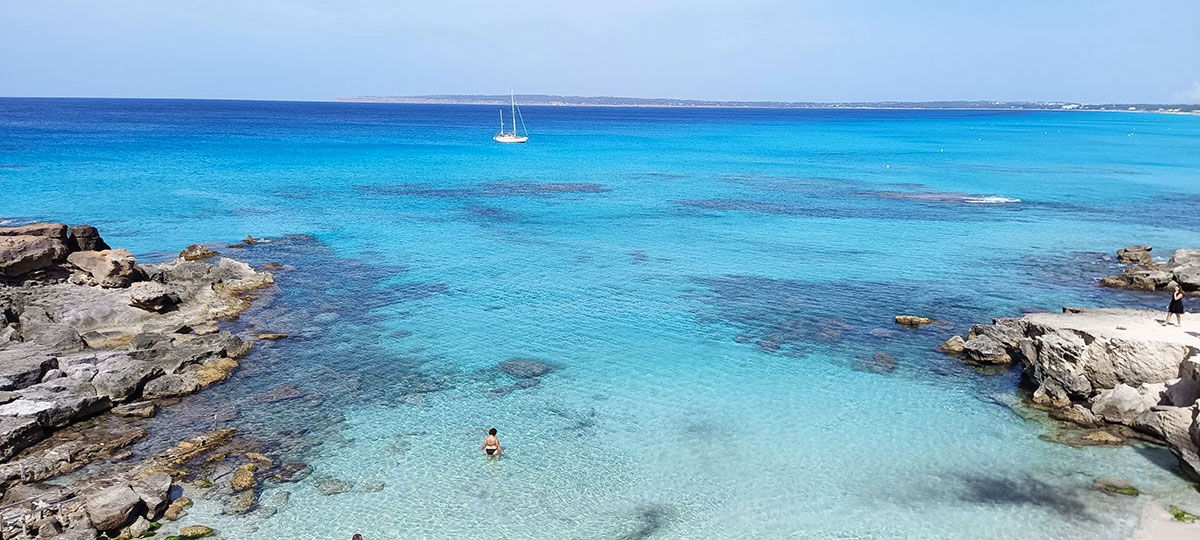
Es Palmador is shallower than it looks. The bare sand strip between Ibiza and Formentera, reachable only by boat, with water so clear the depth reads as half what it is. We check twice at the bow before settling. It is also one of the best anchorages in the Balearics, so it is worth the care.
Aguas Blancas only exists on calm days. A narrow beach on Ibiza’s north-east coast, black volcanic rock at each end, pale sand between. It is exposed, and the swell builds quickly with any easterly. It stays on the plan as a maybe and comes off it without regret.
Ibiza without the part you are imagining
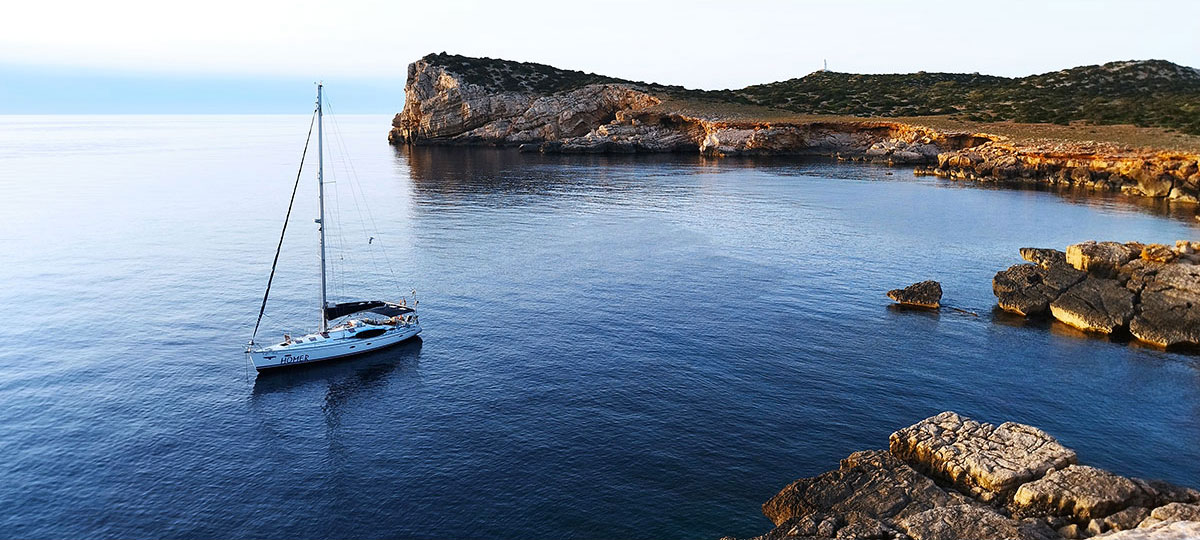
The island has a reputation and it is entirely earned, but it is concentrated in about two square kilometres. From the water you mostly see the other Ibiza: uninhabited islets off the south-west, a lighthouse on Sa Conillera, Es Vedrà rising four hundred metres out of the sea at Cala d’Hort with the light moving across its face at sunset.
Santa Eulalia, on the east coast, is where we take a berth — a calmer town than Ibiza Town, with the white fortified church of Puig de Missa on the hill above it. And Formentera is a slower island altogether: flat, quiet, and best reached the way we reach it, by anchoring off Ses Illetes in water so clear the boat looks like it is floating on nothing.
If your group does want a night out in Ibiza Town, that is easy to build in. We would rather you asked than assumed it was included.
When to go
| Period | What to expect |
|---|---|
| May – June | Best balance. Warm, anchorages empty, Cabrera buoys still available. |
| July – August | Busy everywhere and Cabrera books out weeks ahead. Plan early. |
| September | Our favourite. Warmest water, the fleet gone home. |
| October | Quiet and often lovely, but the crossings need a closer eye on the forecast. |
What a week costs
From €6,000 for the week for the whole boat with your skipper included — about €950 per person with six aboard. Provisioning, fuel and harbour and mooring fees are shared by the group on top, and on this route that includes the Cabrera buoy.
Common questions
Are the night crossings hard?
They are the demanding part of the week and they are chosen deliberately: crossing at night usually means crossing in the calm, and it buys you a whole day at the other end. Most people sleep through the second half. We only go when the window is right — otherwise we cross in daylight and reshape the rest.
Can we start in Ibiza instead of Palma?
Yes, and then there are no crossings at all — Ibiza and Formentera alone fill a comfortable week of short hops. You lose Cabrera and you lose the passages. Some groups want exactly that.
Do I need experience?
No. Your skipper sails the boat all week. The crossings ask for willingness, not skill.
Is this itinerary fixed?
No — except for the Cabrera buoy, which is a date and a number and cannot move. Everything else is built with you and adjusted as the forecast does what it does.
Sailing this?
See the Ibiza and Formentera odyssey, or the Mallorca and Menorca odyssey. Or tell us your dates — the earlier we know, the likelier the Cabrera buoy. You can also read what our crews wrote afterwards.
5.0/5 on Google (9 reviews) and 4.5 on Trustpilot (13 reviews). 22 reviews from crews who actually sailed with us, on two platforms we cannot edit. Read every one of them.