



Sailing from Mallorca to Menorca takes one open-water crossing of about 50 nautical miles, and a full loop of Menorca comes to roughly 170 miles over seven days. We sailed exactly that in late July 2026, anti-clockwise from Cala d’Or: 172.5 miles routed, one night crossing out, one night crossing back. What follows is the route as it was actually sailed, not a brochure version — including the three things that catch people out.
The crossing: about 50 miles of open water
There is no way around it. Between the east coast of Mallorca and the south-west corner of Menorca there is nothing — no shelter, no bail-out, no island to duck behind. At a working average of 6 knots that is eight to nine hours.
Which is why we do it at night. Leaving Cala d’Or in the early evening puts you off Cala en Turqueta around midnight, anchored and asleep before the wind does anything interesting. On our week the forecast had a north-easterly filling in at two or three in the morning — 12 to 13 knots, gusting 17, straight on the nose, with a metre of short chop by dawn. Being anchored before that shift was the single most important decision of the week, and it turned on leaving the dock on time.
The return leg is the same distance in reverse and usually easier, because you can pick your night. Ours was 39.4 miles from Son Saura to Cala Varques in 6 hours 36, wind south-east at 5 to 10 knots on the beam, genoa and a slow engine. We ran the routing for every departure hour between 8pm and 4am and every single one gave 6 hours 36 — so the choice came down to arriving at first light rather than in the dark. We left at 23:00 and made the anchorage at about 06:10.
Leaving from Mallorca or from Barcelona
From Cala d’Or you slip the lines in the late afternoon, have dinner under way and anchor in Turqueta around midnight. From Barcelona you leave at sunset and watch the day come up at sea. They are two different weeks, and they do not suit the same crews.
From Mallorca — 47.5 miles. One evening at sea, just one, and by morning you are already in the south-western coves. It is the departure we propose by default, and the one everything below describes.
From Barcelona — a full night. About 130 miles, 19 hours 54 minutes under way, measured in September 2026. The crossing has a convenient property: its duration does not depend on when you leave — we tested six different departure times and it does not move. So you choose your arrival time and work the departure back from it. You board in the city, with no flight, no transfer and no baggage allowance; the price is a night of watches, sleeping in shifts.
If you are hesitating, leave from Mallorca. A night at sea keeps very well for another year.
Why anti-clockwise — and when it should be the other way
Neither direction is right in the abstract. What decides it is where the wind will be on which day, because a loop of Menorca means the north coast on some days and the south coast on others, and the two behave completely differently.
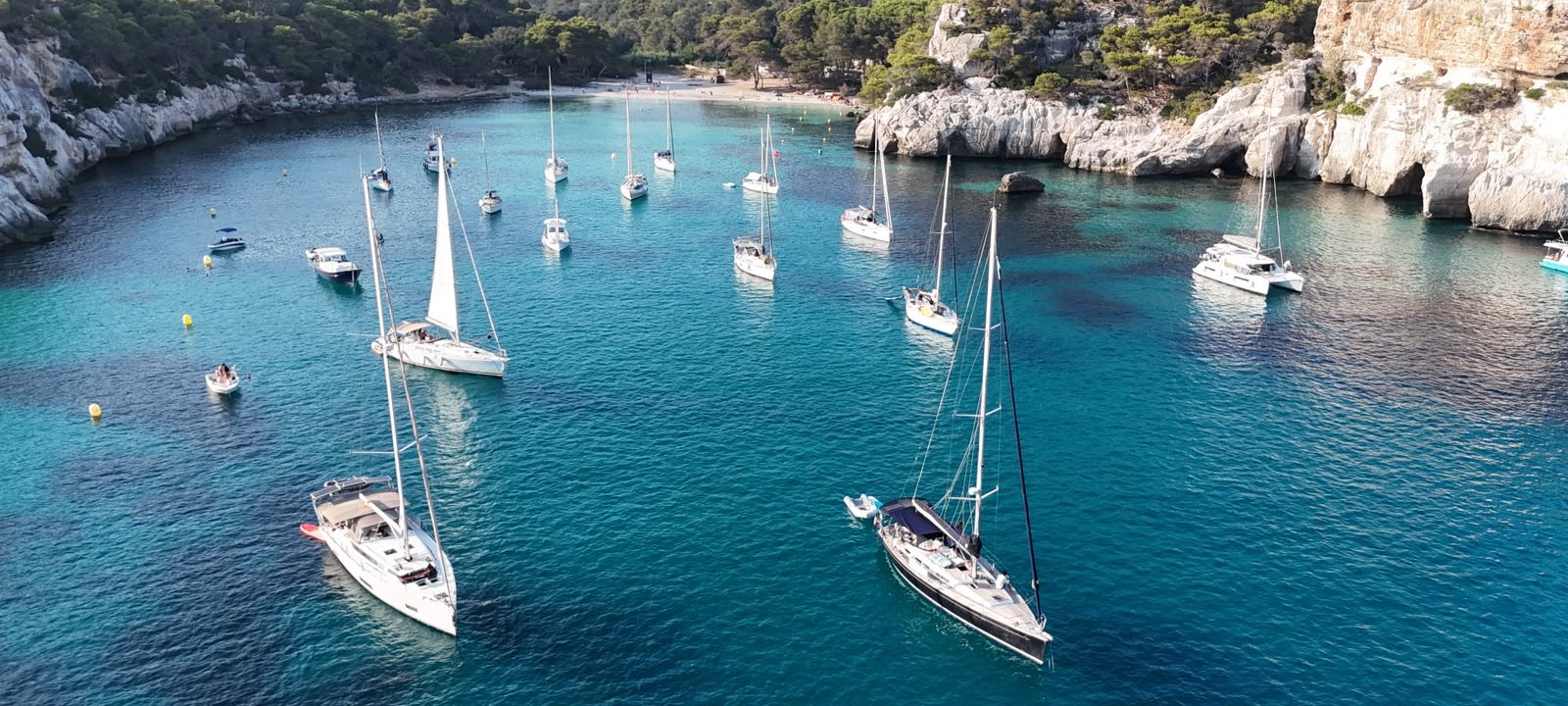
We went east first — anti-clockwise — because the only genuinely windy day of the week was the Sunday, from the north-east. Anti-clockwise put us on the sheltered southern calas that day, and saved the exposed northern coast for midweek, when the forecast collapsed to nothing. It worked: Wednesday on the north coast was flat calm, 0 to 6 knots, half a metre of swell. Pregonda and Cala del Pilar in those conditions are worth planning a whole week around, and they are unusable in a tramuntana.
Reverse the forecast and you reverse the loop. That is the whole rule.
The seven days, anchorage by anchorage
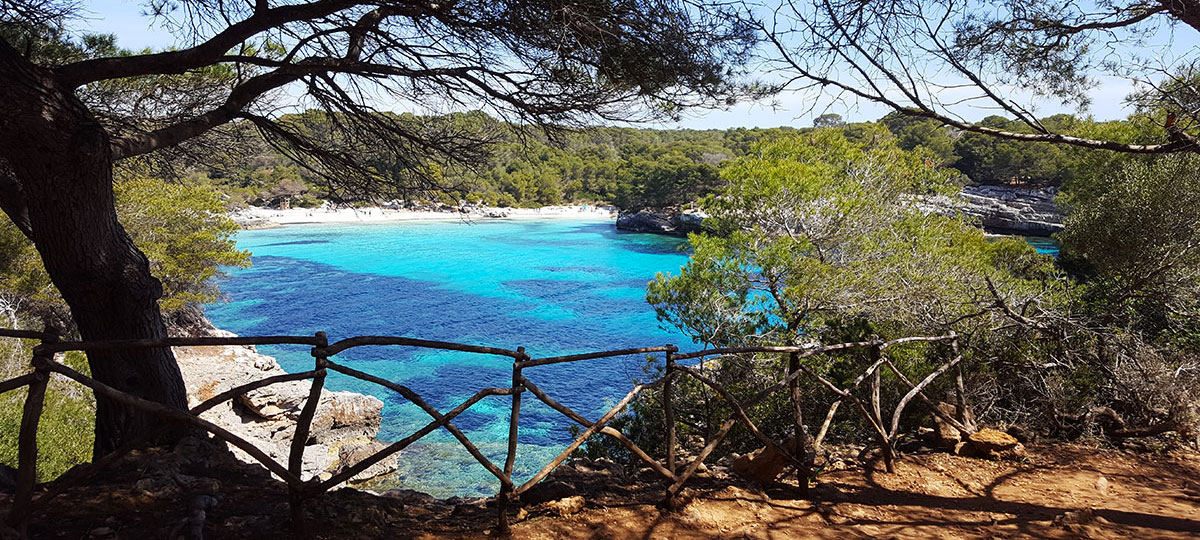
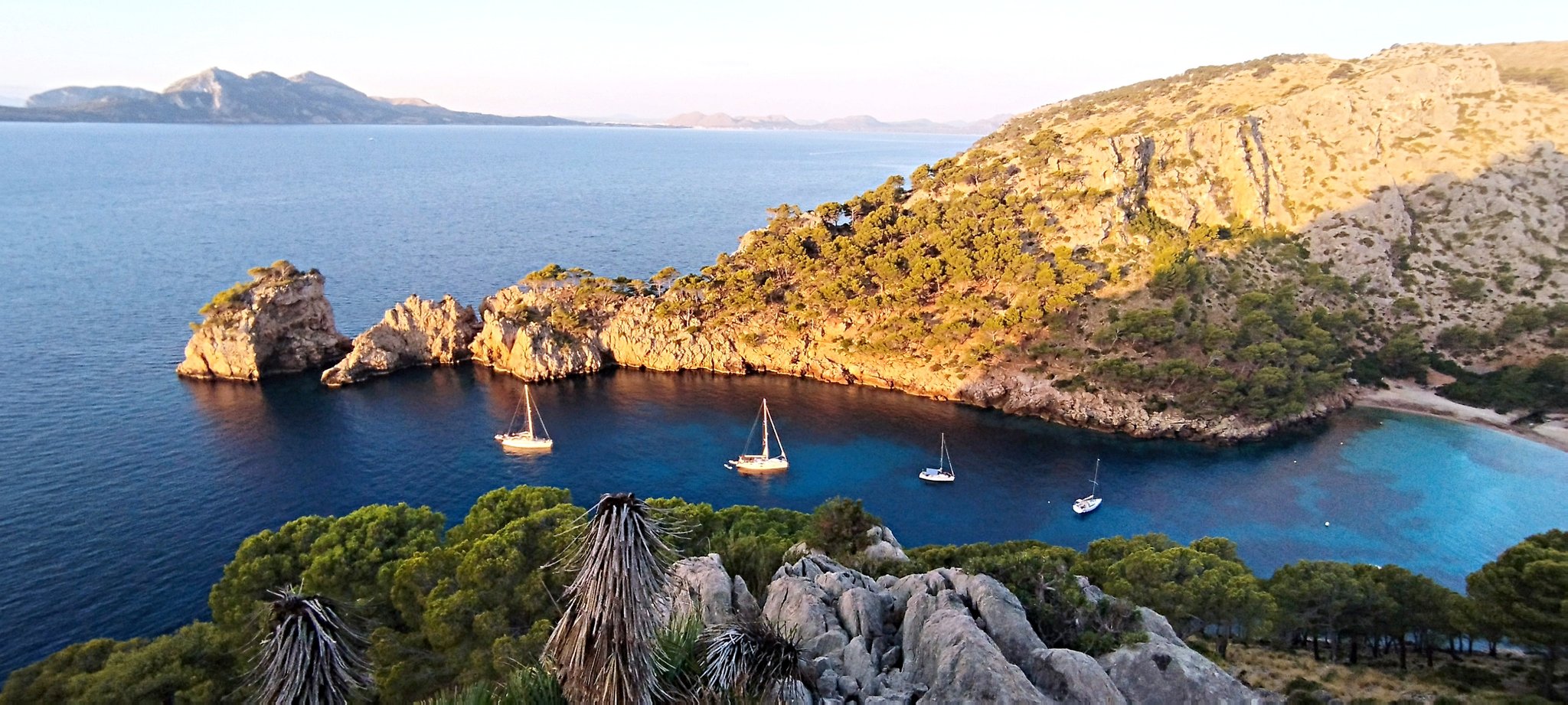
Day 1 — Cala d’Or to Cala en Turqueta, 47.5 miles. Provisioning delivered to the boat, lines off at half past five, dinner under way, landfall around midnight. Turqueta is a double bay split by a rock spur, shallow and turquoise, and the caves in its cliffs were used by fishermen for their nets long before they housed hippie communities in the sixties.
Day 2 — the south-west calas. Son Saura, Es Talaier, Macarelleta, then the night at Macarella. Son Saura is over 500 metres of sand in two beaches separated by a pine wood, with water shallow enough to walk out a long way. Macarella has exactly one establishment, Bar Susy, in the shade of the pines.
Day 3 — Binigaus and the cathedral. Anchor off Sant Tomàs and walk up the Barranc de Binigaus to the Cova des Coloms — a cave 24 metres high with the proportions of a church nave, which is why the island calls it la Catedral. Afternoon at Cala Coves, whose cliffs hold the largest prehistoric necropolis on Menorca: more than ninety burial caves cut into the rock from around 1400 BC.
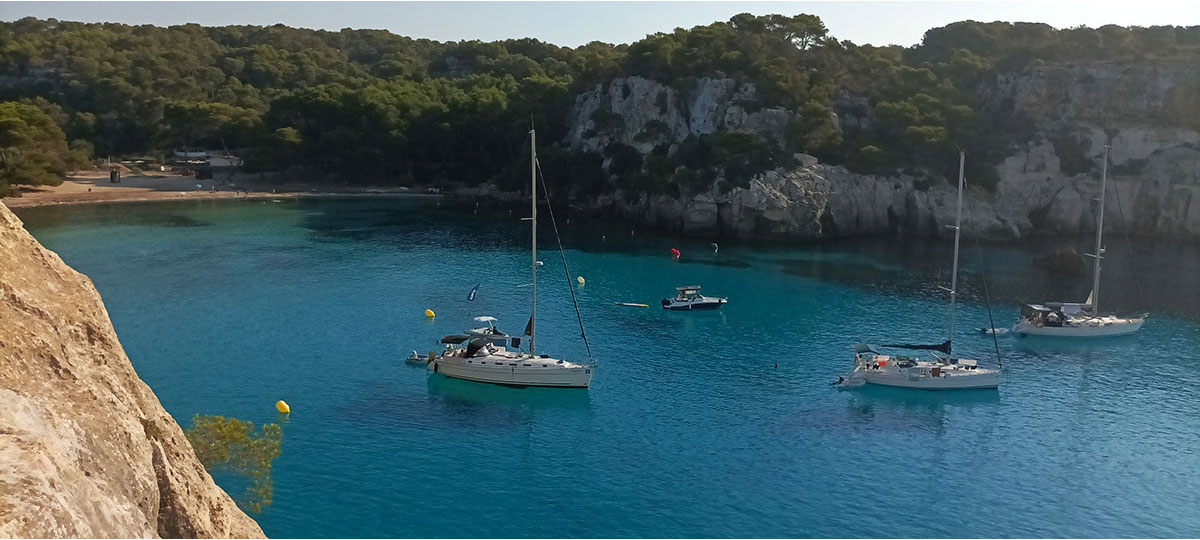
Day 4 — round the south-east corner to Fornells, 31.9 miles. Binibèca, Punta Prima opposite the Illa de l’Aire lighthouse, La Mola, then Illa d’en Colom and the black schist of Cap de Favàritx before turning into Fornells for the night on a buoy. Fornells is the island’s lobster-stew capital and the bay is the third natural harbour on Menorca — long, narrow and genuinely protected.
Day 5 — the north coast, if it lets you. Cala Pregonda, red volcanic sand that got itself onto a Mike Oldfield album cover, then Cala Algaiarens with lines ashore. This is the day that only exists in settled weather.
Day 6 — down the west coast and home, 60.1 miles. Son Saura and Es Talaier again on the way past, dinner at anchor, then away at eleven at night for the crossing back.
Day 7 — Mallorca. Cala Varques and Es Caló Blanc at dawn, Cala Magraner, and back into Cala d’Or by half past six.
The other half of the island
This circuit takes the south and the north coast. It leaves out the west and the north-east, which we sail on other weeks. Here is what is there, so you know what can be traded.
Ciutadella and the Artrutx lighthouse. Ciutadella’s harbour is a narrow canal running into the old town: you spend the night alongside, five minutes’ walk from the windmills and the terraces. You leave at first light, and three quarters of an hour later you round the Artrutx lighthouse, a black-and-white banded tower on a low point. That is the island’s south-western corner, and the way through between the west coast and the southern coves.
Es Grau and Illa d’en Colom. On the north-east coast, a narrow channel between the islet and the village, with the s’Albufera des Grau nature park behind. We spent the night and the whole of the next morning there: the white village set on its hill, boats lying to their anchors, and nothing moving on the water before noon.
Cala Morell. The north-western corner: red cliffs, white houses clinging to them, and an entrance so narrow you only make it out at the last moment. It is the island’s last stop when you head back to the mainland.
Three things that catch people out
Ciutadella will probably refuse you. The public Ports IB berths turn away anything over 12 metres. The Club Nàutic takes up to 18, but in high season it wants a five-night minimum unless you walk in on the day. We never got in, and planned around it rather than counting on it.
Fornells buoys are booked on VHF 77. Ports IB manages the field in the bay; pick-up from 11:00, drop by 10:00, and they will want to see the charter contract. Book it, don’t hope.
There is one fuel station in Mahón and that is your lot. Club Marítimo, on the Moll de Llevant, open 8am to 9pm every day in summer. Menorca is not a place to improvise about diesel.
Picking an anchorage that lets you sleep
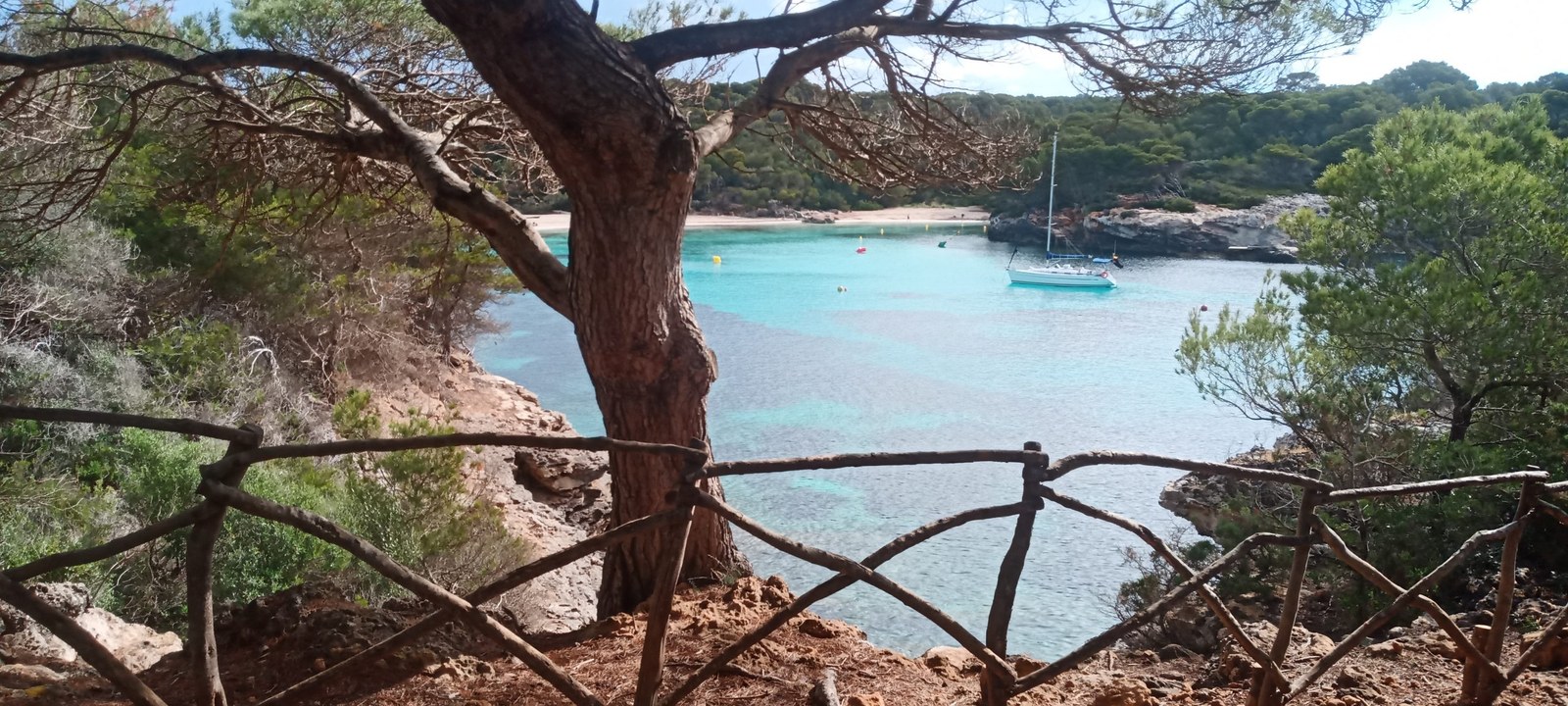
The number that matters is not the significant wave height. It is the direction of the residual swell relative to the axis of the cala, and its period. Anything from 4.5 seconds up starts to resonate inside a narrow inlet, and a boat that is not held straight by the wind will roll all night in what the forecast calls a calm sea.
Our own week is the demonstration. On a roll index we score after the fact, Turqueta came out at 3.2 and rolled — everybody remembers it. Macarella 2.3. Cala Coves 0.4, Fornells 0.8, Algaiarens a flat 0.0. Same island, same week, same forecast.
When to go
| Period | What to expect |
|---|---|
| May – June | Best balance. Moderate wind, empty calas, water still cool early on. |
| July – August | Warmest and most settled, but the anchorages fill and Ciutadella is closed to you. |
| September | Our favourite. Warm water, thinning crowds, reliable weather windows. |
| October | Fine but the tramuntana returns; the north coast becomes a maybe. |
For reference: the week described above ran from 25 July to 1 August 2026. One windy day with gusts to 29.9 knots, then five days at 4 knots or less with swell under a quarter of a metre, and not a single millimetre of rain.
What a week like this costs
From €6,000 for the week, for the whole boat with your skipper included — about €950 per person with six aboard. Provisioning, fuel and port and mooring fees are shared by the group on top. There are never shared cabins and never strangers on board: one boat, one group.
Common questions
Do I need any sailing experience?
No. Your skipper sails the boat for the whole week. You can take the helm and learn as much as you want, or read on deck and never touch a winch.
Is the night crossing hard?
It is the one demanding part of the week, and it is chosen deliberately: crossing at night usually means crossing in the calm. Most people sleep through the second half of it. We only go when the window is right — if it isn’t, we cross in daylight instead and reshape the rest of the week.
Can we start from Menorca instead?
Yes, and the loop then needs no crossing at all — seven days is generous for the island alone. Starting from Mallorca is what turns it into a passage rather than a tour.
Is this itinerary fixed?
No, and it shouldn’t be. It is what one real week looked like under one particular forecast. Yours gets built with you, and then rebuilt during the week as the weather actually behaves. The direction of the loop is decided a day or two before you leave, not in a brochure.
Sailing this yourself?
Have a look at the Mallorca & Menorca odyssey, or at The Quiet Passage, which does the same crossing with six guests, no screens and no alcohol. Or just tell us your dates and we’ll tell you honestly what the week can look like. You can also read what our crews wrote afterwards.
This guide covers the crossing and one real week. For the island itself — 26 anchorages and which way each one opens, the ports that turn boats away, the coast that only opens without tramuntana — see sailing around Menorca.
5.0/5 on Google (9 reviews) and 4.5 on Trustpilot (13 reviews). 22 reviews from crews who actually sailed with us, on two platforms we cannot edit. Read every one of them.